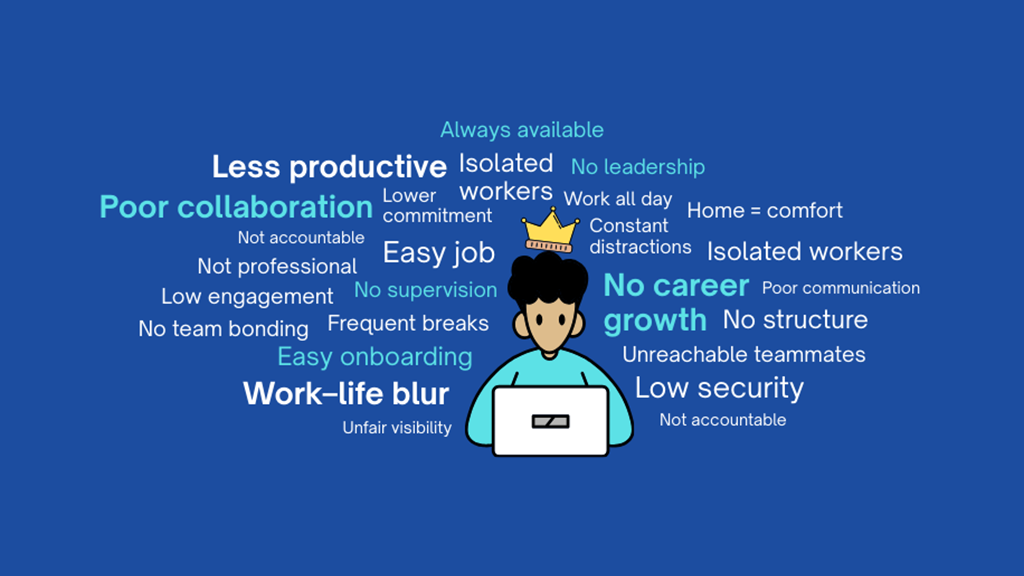
The internet is not as honest as most of us expect it to be. When you scroll through the internet, you will find people making big claims, some with a little truth, and others are myths.
Over time, these half-baked assumptions have transformed into widely accepted facts. Some say that remote employees are less productive, or that company devices are safe once they’re shipped, and that everything magically fixes itself with a factory reset.
But these claims are bogus; remote work is a lot more complex and even more human. And it’s time we let go of the myths that do not serve modern remote work, but it is not the future anymore, but the present.
Myth 1: Remote Workers Spend More Time Offline Than Online
This myth mostly stems from an assumption that if you can’t see someone at their desk, they’re probably not working. If you look at traditional office settings, presence is synonymous with productivity. And remote work breaks that illusion.
Remote employees spend their working hours replying to work emails, working on projects, and staying online on collaboration platforms. Problems usually arise when micro-managing supervisors excessively check up on remote employees and go so far as to use monitoring tools that do more harm than good.
The best way to deal with remote employees is to trust them and set clear expectations with reasonable deadlines, so they can work with a clear mind and stay productive.
Myth 2: People Who Work Remotely, Stink (literally)
What started as a joke has gained momentum, and people almost believe it to be true. Many people think that people who work from home have abandoned basic hygiene. They wake up to alarms, switch on their laptops, and spend the entire day without washing their faces.
But the reality is far less dramatic. Remote work does not sideline hygiene or daily routine. They still take care of themselves and show up to work, attend meetings and work with the entire team. The only difference between a remote and onsite employee is that remote employees do not spend hours coming to and from the office.
In fact, many remote employees report better routines overall. More sleep, flexible schedules, and less stress often lead to healthier habits, not worse ones.
Myth 3: Company Devices Are Safe To Ship
Companies and employees alike are often under the impression that once a company laptop is shipped, there’s nothing to worry about. But company devices do not stay still. They move around with the remote employee, and when that employee resigns, the company device is left hanging in between. One wrong move and the laptop is lost, damaged, or endangered.
This is where many teams run into trouble. Distribution is easy. But retrieval is not. When an employee leaves, relocates, or stops responding, getting that device back can quickly turn into a headache.
In situations like these, services like Remote Retrieval come in. Instead of relying on
reminders or crossing fingers, hoping that the laptop is safe, you should let an expert handle the retrieval.
Myth 4: IT Is Not A Concern When Working From Home
Some companies assume that once their employees are working from home, there is no need to worry about their IT needs. Companies do not install firewalls on laptops for remote employees because they do not consider it a threat. But remote employees can unintentionally expose sensitive data.
Remote employees can make many mistakes at home, which can become problematic for IT teams and HR in some cases. Even the most routine tasks require oversight, and if the process isn’t clear or the device is mishandled, it can become a serious compliance or security issue.
Myth 5: Lost Laptops Are No Big Deal
After losing a laptop, it is easy to simply shrug it off and deem it a mistake. You may think that it’s unfortunate and that you can simply get a new one, disable a few accounts, and you’re good to go, but this is where bigger mistakes breed.
When a company laptop is lost, it takes sensitive data, saved credentials, and access to company systems with it. Even if you change passwords or block the accounts on it, the risk remains.
And there are more downsides, such as increased operational costs. This includes replacing devices, setting up new hardware, and dealing with internal investigations, all of which take time and money.
This is why it is all the more important to use retrieval services like Remote Retrieval to avoid losing company devices and not take lost devices too lightly.
Myth 6: Offboarding = Exit Interview
In a remote setting, offboarding is not just a checklist item that the HR can tick off or an exit interview that ends on a good note. Remote companies have employees scattered all over the world in different countries and across cities. Which means that once an employee resigns, the company will have to retrieve the laptop and other gadgets. But without a clear plan, laptops and monitors can disappear quietly.
This is why you must include remote asset retrieval in your policy so that employees and the HR department knows what to do in these situations and ensure safe recovery.
Myth 7: Remote Teams Are Easy To Scale
Hiring more people does not scale remote teams. There is a lot more that goes on in the background, for example, for each person you hire, you have to ship devices, manage software licenses, and set up accounts. And you also have to keep track of who has what.
If you do not have a plan in place or a system that works, your assets will start slipping through cracks, and retrieval can be so messy. Always have a structured approach that allows you to track, ship, and return each device systematically.
Myth 8: Remote Work Is Just A Phase
If you still think that you’ll be back in the office soon, then you could be wrong. Remote work is here to stay, and the companies that are still clinging to the hope of it being a temporary arrangement are unprepared.
Remote work is seeping into the new normal, and if you have unclear procedures or outdated policies and barely functioning IT systems, then you are bound to struggle down the road. Work on proper remote policies, manage devices, and track assets so that remote work is a standard part of your team rather than just a risky side hustle.
Myth 9: Office Devices Will Come Back On Their Own
Wishful thinking doesn’t always lead to good things. Many companies assume that once a device reaches an employee, they won’t have to worry about it and it will eventually find its way back to the company. But that almost never happens.
Devices are used, forgotten, and sometimes even repurposed without anyone ever noticing. If your company’s laptop is sitting on your former employee’s desk for weeks or months, the security risk increases, and you may never get it back.
Therefore, it is best not to rely on optimism and set up a structured retrieval process.
Myth 10: A Factory Reset Solves Everything
Do you still think that a factory reset is enough to wipe the data and get rid of the risk? It is not that simple. A factory reset only wipes the data on the surface and does not address the physical side of device management. All the lost laptops, unreturned monitors, and other misplaced gadgets store a lot of sensitive data that needs to be destroyed properly.
Companies should not rely on factory resets for devices by remote employees and maintain better control over the full lifecycle of every device.
It’s Time These Myths Retire
Remote work is here whether we like it or not, and these myths only go to show that outdated assumptions can create real problems. But the solution isn’t to panic or micro-manage, but it is to put the right systems in place to manage it all.
Remote Retrievals provides easy asset retrieval, ensuring your devices are returned securely with all private data intact. The takeaway from all of this is that remote work can be seamless once you stop believing myths.