
Here’s one thing most IT leaders didn’t anticipate: Fully remote work was actually easier to manage from an equipment recovery standpoint than hybrid work.
It was a frenzy in 2020 during the COVID-19 pandemic, when all employees went to work from home. It was a uniform chaos. All of the laptops were in someone’s home. You had an address. You could send a label. While this was not ideal, the process was clearly defined.
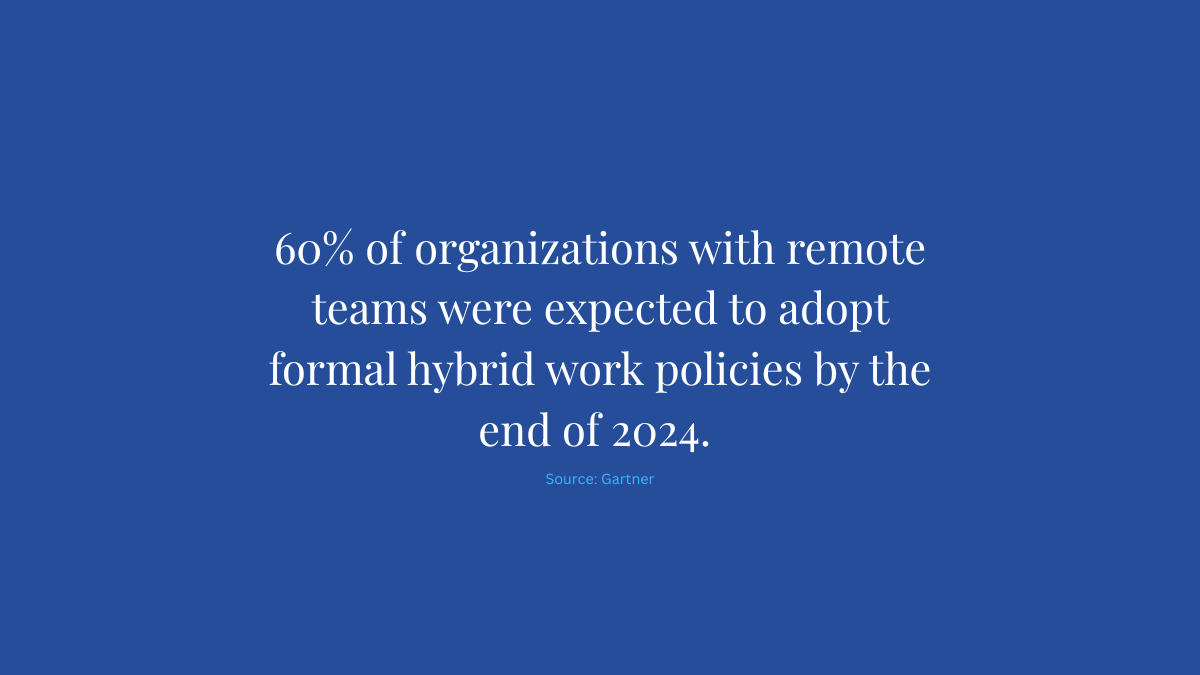
However, according to Gartner, 60% of organizations with remote teams will have adopted formal hybrid policies for employees by the end of 2024.
Now, if we talk about the hybrid work setting, there is no designated space. One staff member works from home on Monday and Tuesday, is present in the office on Wednesdays, and uses the desk of that local co-working space on Thursday.
Another employee divides his time between two cities. A third has just begun working out of their parents’ house this summer without informing anyone. And thus, each hybrid employee has a different one.
If one of these employees gets fired or resigns from their position, it is a real headache for the employer to retrieve the laptop they were given because there is no specified location to track it.
Schedule a Laptop Retrieval Today
In this blog, we will discuss the issues arising from hybrid work settings and ways to resolve them, so read on if you are an employer looking to manage your hybrid teams without risking the laptop.
Why Is Managing Hybrid Employees More Difficult?
The location of remote employees is known and easy to track for organizations, which is not the case with hybrid employees.
1. Fixed Address vs. Variable Workplaces
The employees who work fully remote keep their laptops at home or at a single place where they work, with IT logged in. In case of offboarding, a courier can easily reach that single address and retrieve the laptop.
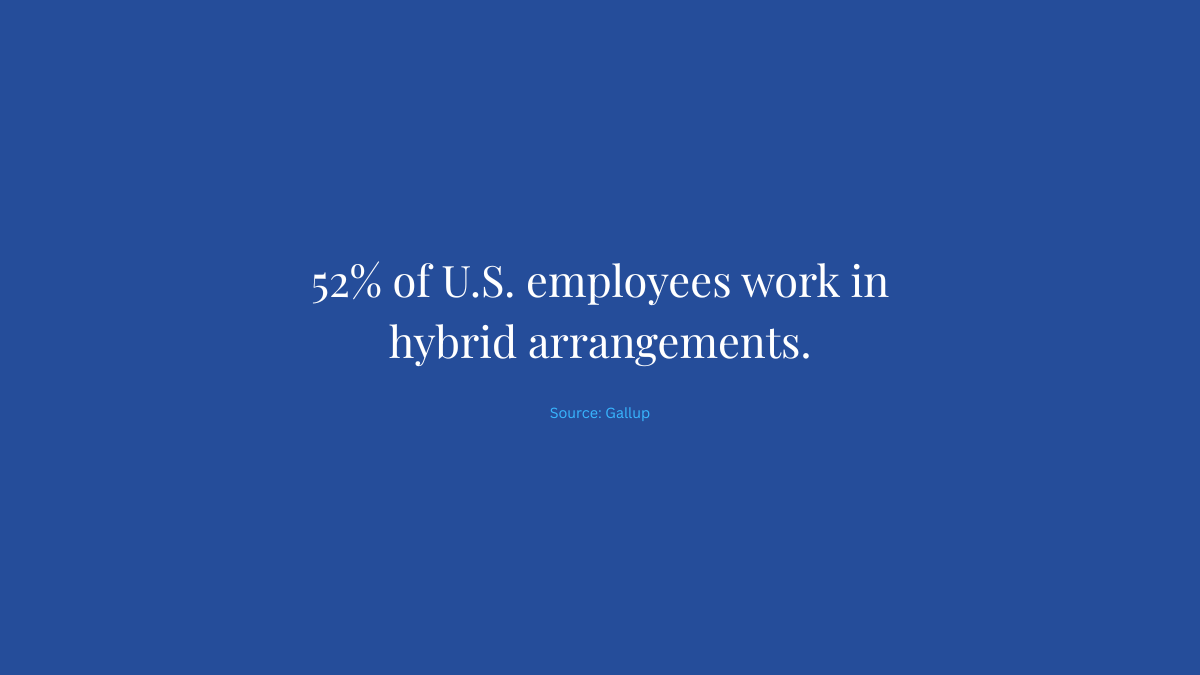
However, with the hybrid work setting, you cannot assume that there is a single address for the employee. A report by Gallup shows that 52% of the employees in the US are working in hybrid arrangements. This means the employees are splitting their time between home, the office, a cafe, or wherever they find it convenient to work. Hence, the devices used by that hybrid worker can be at any of the following locations:
- Home
- Office desk
- Co-working space
- House of a friend or family member during the weekend
- A hotel room during a work trip
And there are even more possibilities. In such a case, when the employee is offboarded, it is a headache for IT to determine the exact location to retrieve the device.
2. False Sense of Control
It is a common belief among IT teams that laptops from hybrid teams can be easily recovered. Why? Because at least they come to the office someday, and they can simply hand it over to the management on their last working day. However, this assumption cannot always hold because resignations do not always align with office calendars.
Most of the time, employees are terminated on any day of the week. If the employee’s working days in the office are Tuesday and Thursday, and they’re fired on a Friday, that laptop is not going to be seen for three more days at least.
Voluntary resignations are even more complicated. Many workers take the final two weeks off work but work from home, rather than experience the discomfort of a long goodbye in person.
Even when everything else aligns, and the employee is present in the office physically, chances are that the employee leaves the office premises with the laptop in their bag when no clear IT offboarding checklist is put into place.
3. The Multi-Site Location Gap
The location problem becomes even worse if your organization is located in several cities. A hybrid employee may have a formal job role in your Chicago office but has been working in the Dallas office for the last 3 months.
Their device record would still show Chicago, and the Chicago IT takes over Dallas when the offboarding or onboarding process begins. However, the Dallas IT wouldn’t be aware of anything, and during this process, the employee is already out with the device.
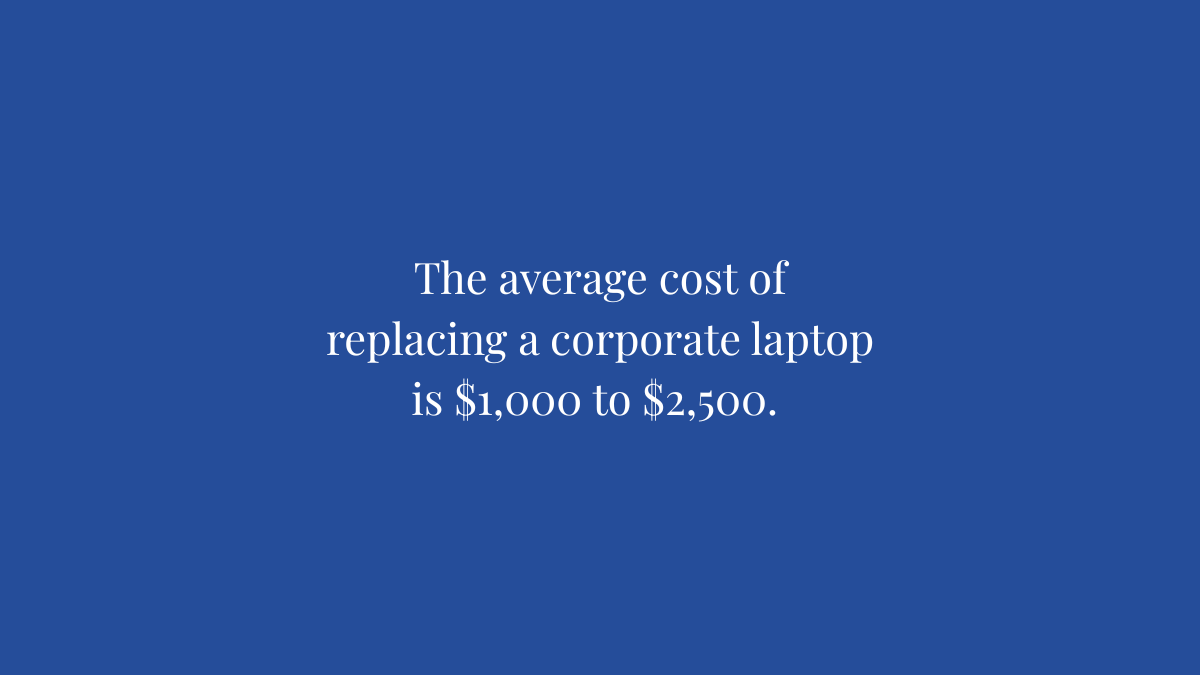
The average cost of replacing a corporate laptop is $1,000 to $2,500. That’s real money. However, this is not the only thing you risk losing. So much of your confidential company data also goes with the lost device, which may result in a data breach if handed into the wrong hands.
Which means the loss of a laptop is not just losing a device; it is a liability and can result in many consequences.
Why Does Offboarding Get Messier With Hybrid Workers
Hybrid offboarding isn’t simply an extra step or two in the process. It messes with the entire process that most IT and HR teams have been following.
• A Linear Process That No Longer Applies
Full remote offboarding, at its best, looked like this:
- HR notifies IT of departure
- IT triggers remote wipe
- Prepaid label goes to the home address on file
- The device comes back within a week
Even that was not perfect, but it was linear, and the management was aware of the steps and destination.
Hybrid offboarding disrupts that process at every turn. The device’s location is unknown. The employee might not be available at the beginning of the process.
The "home address” on file may be six months old. The time between a resignation and the last day is often so short that coordinated retrieval is virtually impossible to pull off. And when you are not sure where the device is, expect delays after delays.
• Perception Of Ownership
The psychology of a hybrid worker about their laptop is very different from the psychology of a fully remote worker. The mental model is clear when someone is fully remote.
The laptop is a work tool. It stays at the pace at which you are working. It was given by the company, and it will be taken back by the company.
However, in the case of a hybrid employee, that laptop is with you in the office, at home, out on the road, and pretty much everywhere else. After a year or two of that, it’s no longer borrowed equipment; it feels like yours.
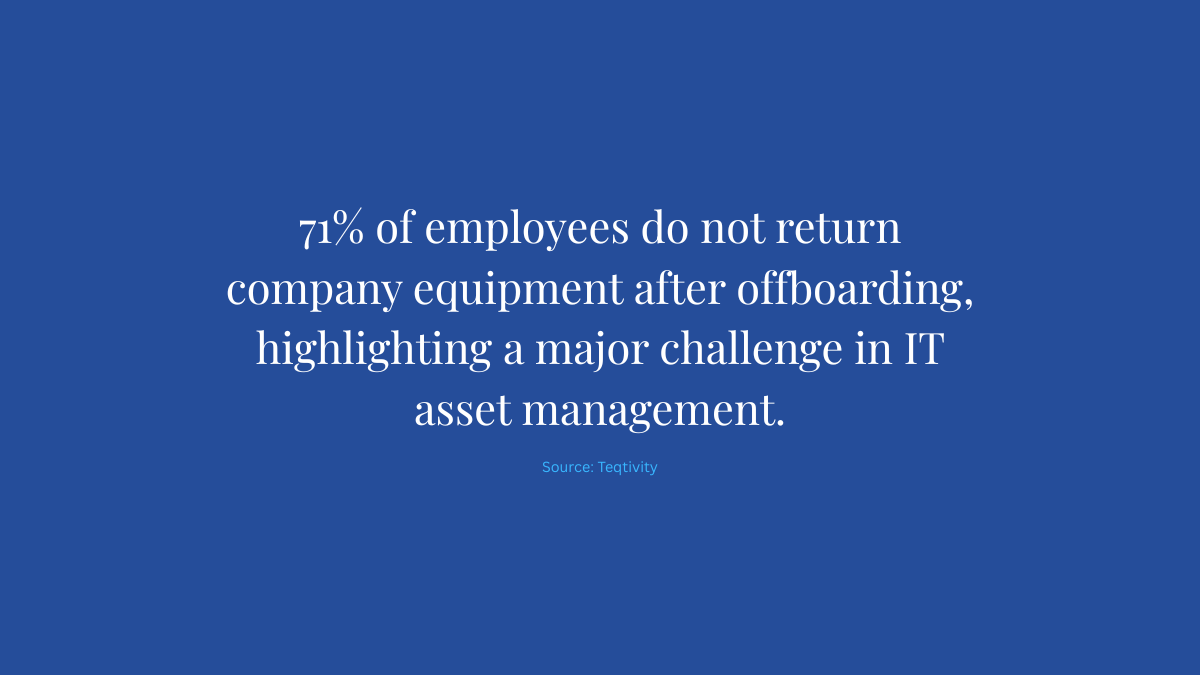
This change in attitude is significant when it comes to returning it. Requests for retrieval are more intrusive. Return dates are disregarded. Staff doesn’t follow up. Some research says that 71% of employees do not return the company equipment after offboarding, and this number tells a lot.
• Fragmented Accountability Across Teams
One of the biggest reasons behind this pattern is a lack of accountability, or the teams are not sure who is accountable for what.
IT thinks the return instructions are being sent by HR. HR assumes IT has already triggered the label. And amidst this confusion, the employee keeps on waiting, and no one reaches out in time. And finally, on the last working day, the employee takes the laptop home.
This problem is particularly acute for hybrid working models because, in fully remote organizations, the offboarding process was supposed to be handled centrally, as there was no office to return to.
In hybrid organizations, central ownership is rarely achieved, as they assume that physical proximity would fill the gap. But it doesn’t, and the organization ends up losing the laptop.
Schedule a Laptop Retrieval Today
How To Make Hybrid Equipment Recovery Easier?
Recovering the laptop from hybrid employees is not impossible, but it needs some strategic decisions. And the companies must treat laptop retrieval as an operational function and not something that should be taken care of once the problem has already occurred.
• Establishing Accurate Device Location Records
One of the most important steps you should take in order to retrieve the laptops from hybrid employees does not involve making heavy investments in technology. All it needs is for you to improve the process.
You should confirm your employee’s location at regular intervals. Don’t just record it at the time of hiring and forget about it. For a rough idea, you can confirm it.
- At the time of annual performance reviews
- At the start of each quarter
- While initiating offboarding
That is it. Update your asset records according to these three touchpoints, and you are sorted.
• Risk-Based Retrieval Protocols
Not every employee leaving the company poses the same risk, and neither is retrieving every employee’s laptop equally urgent. You should consider a framework for urgency to decide your retrieval strategy:
- Low urgency: This is when the employee resigns voluntarily, there is an extended notice period, and the employee does not have access to any sensitive information. In cases of low urgency, laptops can be recovered in a two-week window.
- Medium urgency: Such cases include situations where the employee resigns voluntarily but has access to sensitive data. Retrieval should be made within 2-3 days here.
- High urgency: These are the cases when the employee is terminated and has access to confidential information like customer data, access to the financial system, etc. In high-urgency cases, the laptop should be retrieved on the same day or the next day.
You can rely on Remote Retrieval’s nationwide logistics network for high-urgency retrievals. They will help you retrieve your laptops on the same day or the next day from the hybrid employees, even if their address is not confirmed by tracking laptops across multiple remote locations.
• Contractual Obligations For Equipment Return
You cannot just expect your employee to return the laptop out of courtesy once their serving period is over. Such informal expectations will not help you when the risks are high.
You should include specific terms regarding the return of equipment in the employment contract and have them sign it to be legally risk-free.
The employment agreement should include the following:
- The timeline for returning company equipment after separation
- The employee’s responsibility is to report the current location of the device when requested to do so.
- The repercussions of non-return include financial liability.
If the employee fails to return on the said terms, you have the documented evidence to follow up. Moreover, you also have the legal right to recover your laptop.
• Partnering With Specialized Retrieval Service Providers
The IT or HR department of a company may not be an expert in logistics operations. And these logistics become even more complex when the hybrid employee lives far away from the office. While the IT team can process the retrieval, it would be slow, expensive, and inconsistent, since it is not handled by experts.
However, when you employ a dedicated laptop retrieval service, you do not have to worry about these things because with them you get the following:
- Nationwide coverage, so it does not matter where the device is
- Professional packaging to avoid damage during transport
- Documentation throughout the process for compliance audits
- Certified data destruction confirmation
This is what the in-house IT teams cannot manage to do efficiently, and you need experts to handle the situation.
Conclusion
Hybrid work isn’t going away. McKinsey shows in one of its research studies that 87 percent of employees take flexible arrangements when offered, and most expect them to be a permanent part of how they work. That means the complexity hybrid work introduces into laptop retrieval isn’t a temporary problem to outlast. It’s the new baseline.
Organizations that haven’t updated their retrieval processes for hybrid reality aren’t just dealing with occasional lost laptops. They’re running a process that was designed for a workforce model that no longer exists. Every departure is a test of that gap.
The good news is that the gap is fixable. Better location data, tiered retrieval protocols, clearer contractual obligations, and the right vendor partner can bring hybrid equipment recovery up to the standard that full remote organizations spent the pandemic building.
It doesn’t require a massive investment. It requires treating retrieval as a real operational discipline instead of an assumption.
If you could relate to any part of this blog, you are not alone. There are so many IT and HR teams responsible for the offboarding process for the hybrid workforce, and it gets complicated when it comes to retrieving the company’s assets. Nevertheless, with professional support, this will be easier to manage.
Remote Retrieval can help you retrieve the laptop in the safest condition through a hassle-free process. Contact us today for reliable, professional services.
Schedule a Laptop Retrieval Today
Frequently Asked Questions
Here are some common frequently asked questions!
Why is it harder to retrieve a laptop from a hybrid employee than from a remote employee?
All devices are assigned to the home addresses in the full remote working mode. You sent a label, and it came back. With a hybrid, the device could be at the office, at home, or somewhere in between. If someone resigns or terminates without following the proper offboarding checklist, it is often difficult for IT to track the laptop.
Why is it important to chase an old laptop?
Old laptops still contain credentials, cached data, and local files that may pose actual liability to the company in the event of a data breach. Moreover, it also has a resale or recycling value, which is generally sufficient to cover the cost of retrieval. Writing off a device just because it is old is a huge mistake.
What is the time frame for retrieving a laptop after someone leaves?
This depends on the circumstances. If someone is leaving with 2 weeks’ notice and does not have access to sensitive systems, then a 1-2 week return time is acceptable. Same-day or next-day retrieval is the target if it is an involuntary termination or the person had access to financial data or customer records. Each day it stays outside is a day of unneeded danger.
When is it appropriate to use a third-party retrieval service?
A third-party retrieval service ensures you receive your valuable assets from various locations without damage. Here is when you should consider using it:
- When internal logistics no longer work.
- When your team is located in various cities around the globe
- When returns are constantly missed
- When the laptop has a very sensitive termination that requires quick action,
In all such cases, a specialist is the best choice. IT teams are not logistics teams, and the price of a failed retrieval is almost always higher than hiring professional assistance.